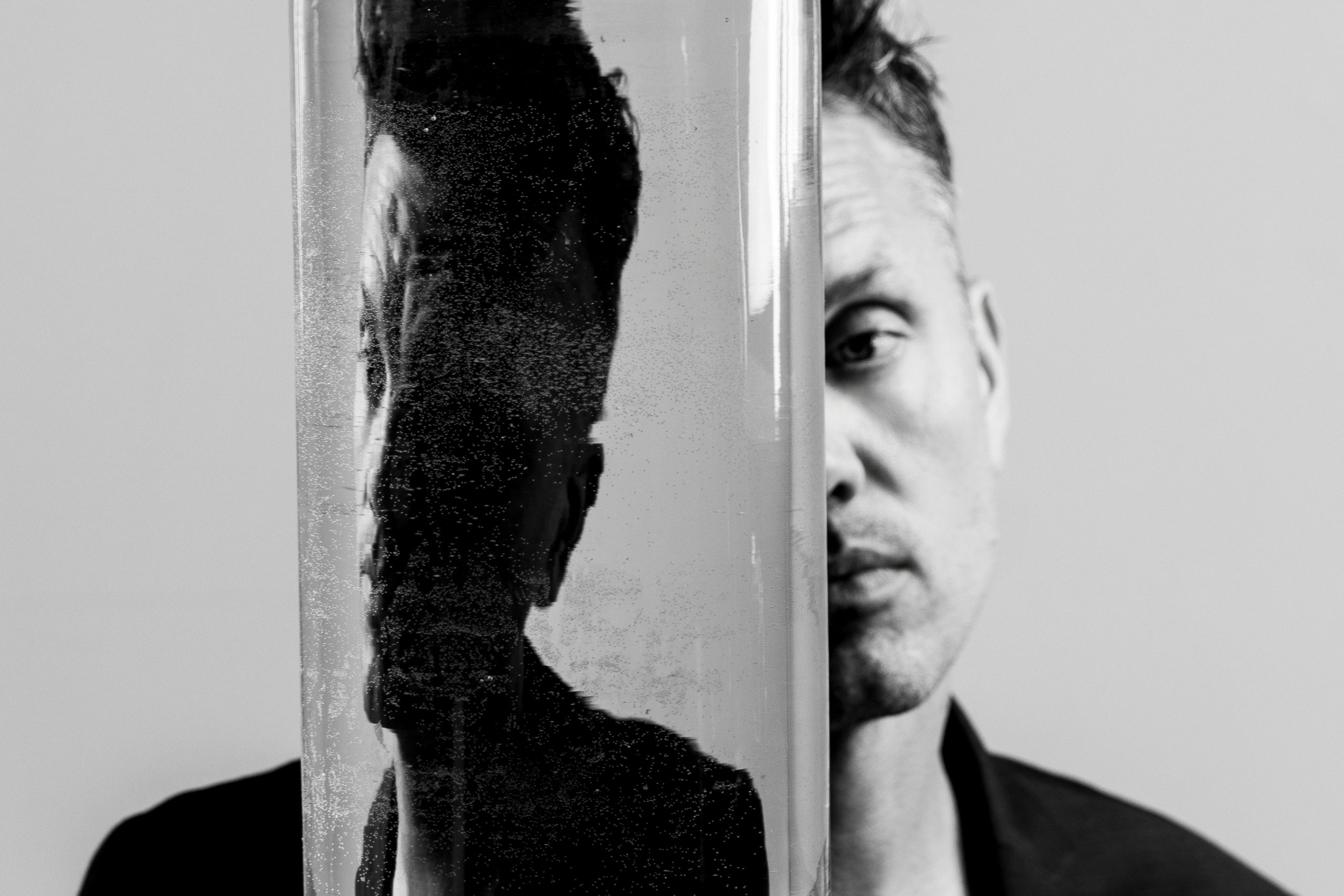
Daníel Bjarnason joins our Zoom call from Bologna; he’s already bounced between Iceland and abroad multiple times in the past few weeks. The established composer and conductor has been at the forefront of new Icelandic orchestral work, sitting as the artist-in-residence of the Iceland Symphony Orchestra from 2015 to 2018. Now, working once again with Iceland’s symphony, his latest album — The Grotesque & The Sublime — will be released on February 27.
“I think it’s a good title for the album in general, because it does deal with the interplay between light and darkness, moving from the living into the underworld, and reflecting on that journey,” Daníel explains of the evocative, diptych title. The title of The Grotesque & The Sublime, along with titles of movements in the concerto “FEAST,” are pulled from the language of Edgar Allan Poe; it’s all “from that world, this sort of ‘goth horror,’” as Daníel puts it.
The middle work — “Fragile Hope” — is perhaps the most gripping of the three on The Grotesque & The Sublime. “Fragile Hope” is a 14-minute homage to the late composer Jóhann Jóhannsson, a collaborator and friend of Daníel’s, which reprises melodies from Jóhann’s acclaimed 2002 album, Englabörn. “I do write, in the notes for that, it is a reflection on the beauty that he brought to the world through light and darkness,” Daníel says, evoking the juxtapositional nature of the album’s title.
Home team
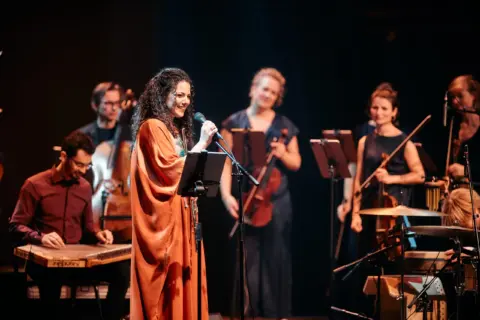
Daníel recorded The Grotesque & The Sublime with his “home team,” the Icelandic Symphony Orchestra. “As a composer and also conductor, to have that kind of connection with a group like an orchestra is really important because it means that you feel confident in performing with them, trying out new things with them, recording. It’s like a long-term relationship, you know, it adds layers,” he says.
Having worked with the orchestra for many years, Daníel notes that he’s forged a strong connection with the group. “I know the musicians personally, many of them are actually good friends. So I think that just builds a level of trust and understanding between us — a lot of things become easier, you don’t have to explain as much.” “It is a reflection on the beauty that he brought to the world through light and darkness.”
“Fragile Hope” sits in between two larger concertos: “FEAST” and “Inferno.” These are written for soloists with an orchestra, each sitting close to half an hour with multiple movements. Daníel’s been working on these pieces for a while, sharing, “‘FEAST’ was actually written for Víkingur [Heiðar Ólafsson, the Grammy Award-winning pianist], he’s an old friend of mine, and he premiered it in Los Angeles, I think maybe in 2019.” In the recording of The Grotesque & The Sublime, however, pianist Frank Dupree took the piece.
The latter work, ‘Inferno,’ was also written for a different person than the one on the recording: Austrian percussionist Martin Grubinger. “He decided to retire at the old age of 40,” Daníel laughs. “So he stopped performing, and this was actually the last piece he played with an orchestra, in Paris.” But, as life goes, the piece was given to Vivi Vassileva, Martin’s student and protégé. Daníel explains that Vivi “has something of the same incredible energy that [Martin] does, on stage and as a performer.”
Daníel notes that, despite each work having its own defining aspects, the three pieces form a cohesive whole in The Grotesque & The Sublime. “Their subject matter is connected, in a way. They were actually written during Covid or finalised around there… Two of the pieces may be categorised as ‘Dances of Death’: ‘FEAST’ and ‘Inferno.’ And then, the third piece is a reflection on the untimely death of Jóhann, and a testament to his life.”


Contemporary classical
Throughout the pieces, Daníel experiments with the traditional orchestra; at some points, brass instrumentalists are instructed to just blow air through their instruments without playing notes, for instance. This continues a hallmark of Daníel’s work, where he straddles traditional orchestral styles and more innovative aesthetics — a contemporary musician who conducts an orchestra classically.
“I try to pick up whatever I feel serves the music that I’m writing — and that includes using extended techniques as part of my palette, to create the sound world that I want — without the technical aspect necessarily being my main focus,” he explains, then contrasts it with, “I also employ the orchestra in a more traditional way, and love to tap into the way of playing they have been optimized to do for hundreds of years.”
“It’s all a part of the orchestral palette that I feel free to draw from,” he states. “I feel like it is a part of the whole tapestry.”
Creativity and aliveness
Daníel stands out, being a composer from Iceland. “In general, there’s not a tradition or culture for understanding conductors in Iceland, but I think there are more and more young people starting to be interested in conducting,” he explains. “That is definitely a shift, and that’s how it happens: it becomes an increasing part of the fabric of the music life; whereas, for a long time, it was only me and a handful of others who were doing it.” Looking to the future, he says, “I’m happy that there are more conductors coming up, and hopefully there will be a lot more Icelandic conductors.”
In addition to keeping an eye on Iceland, Daníel is working around the world as a composer. He attracted significant attention a few months ago when it was revealed that he conducted the London Symphony Orchestra on Spanish pop artist Rosalía’s recent sensational album, LUX. “You don’t have to listen to it any specific way. There’s not any hidden message that you are supposed to decipher.”
“That album was a long process, of course, and I’m just a cog in the machine. I love being a part of these different kinds of projects — new experiences with different kinds of artists,” he explains. After a phone call with producer Noah Goldstein — whom Daníel learned had a connection to Iceland himself, having interned at Greenhouse Studios at the beginning of his career — Daníel worked a few “long and intense days” conducting for the album. Then, it was a wait of a year until the album came out; Daníel explains he “signed an NDA to not breathe a word about this to anyone,” so his credit being on the album hit Iceland by surprise.
Being tapped to conduct for international projects, alongside having a significant upcoming personal work, I ask him if he’s able to pinpoint what defines and differentiates him as a conductor. “It’s not something I think about that much,” he admits. “I generally see myself as a conducting composer, in a way. I have that sort of sensibility as being a composer, conducting fellow composers’ music.”
He also points out that what works for him is “just a sense of creativity and aliveness about the music being created in the moment. It’s like a living thing,” he emphasises. “It’s not something that is this immutable object of notes that you have to, like, worship the altar of the old composers, which is an approach that I’ve always found a bit turgid somehow.”
Storytelling
Daníel explains that, compared to his previous work, his sense of storytelling is more prominent. “It’s quite theatrical music, in a way, and I allow myself to follow that dramatic arc of storytelling, rather than thinking too abstract,” he notes.
“I would say to anyone, to be open to experiencing it, and let it take you wherever it does in your mind. You don’t have to listen to it any specific way. There’s not any hidden message that you are supposed to decipher, or [you are] not supposed to feel a certain way. It’s all in the listener’s mind, and that is when the music comes alive,” he says, then emphasises, “I hope it can inspire some ears to open up.”
Concluding, he suggests, “All people need to do is listen, actually listen. Just let it take you on a journey.”
Daníel Bjarnason’s The Grotesque & The Sublime will be released on February 27. You can listen on most streaming platforms, or buy the record on sonoluminus.com