Fiddle workshops, embroidery, a feast, poetry, and a folk DJ set: this is the 2025 Vaka Folk Arts Festival. Since its inception in 2015, this festival has celebrated the folk arts traditions of Iceland and beyond, spanning music, dance, spoken word, and art.
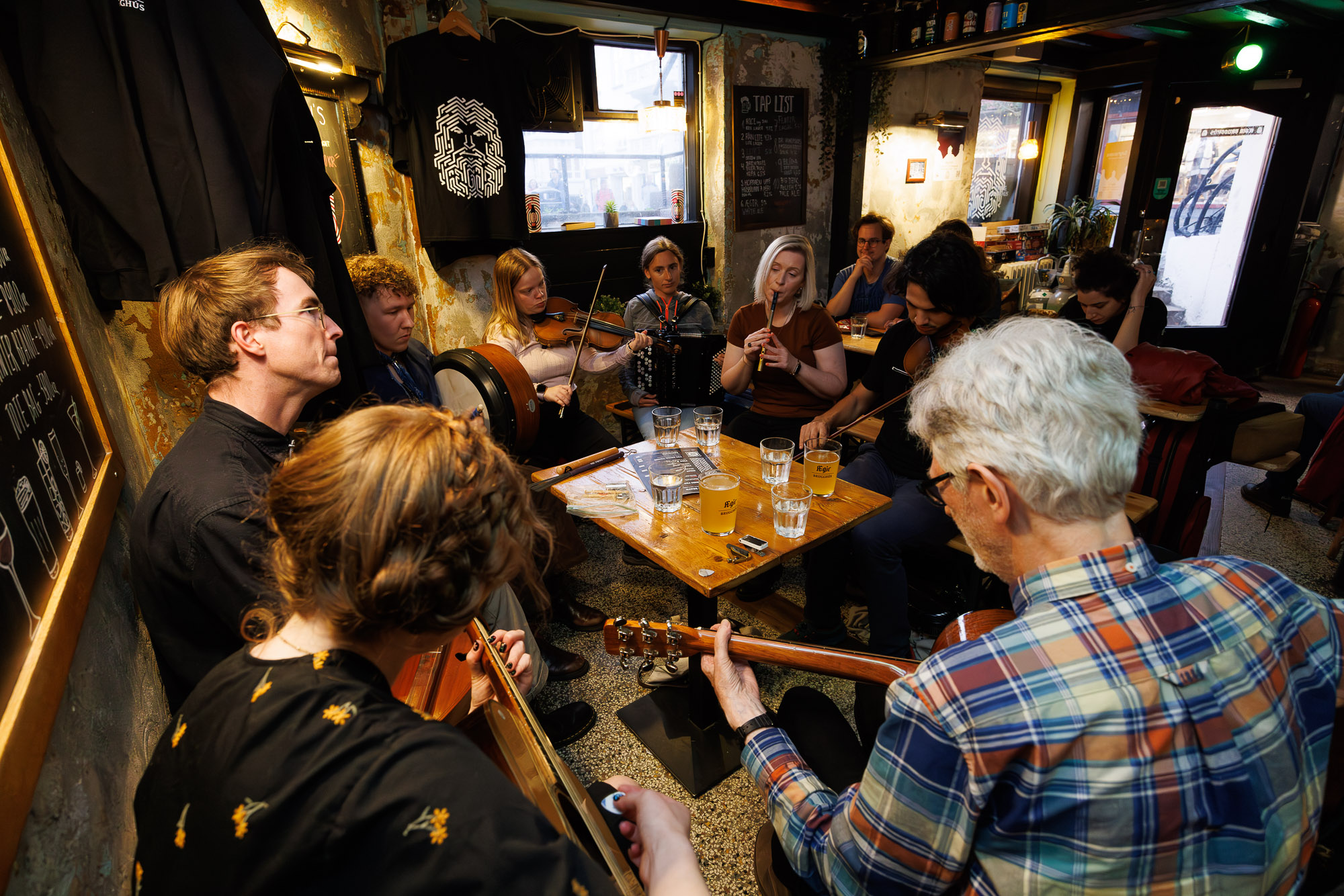
“I think there’s a misconception sometimes about events like this: that it’s going to be kind of boring, and it’s going to be older people, and it’s going to be quite rigid. And we’re just blowing the lid off. We’re just like, ‘everybody in!’” says board member and festival organiser Josie Anne Gaitens excitedly, donning nails painted in the festival’s signature flowery brand identity. For years, the folk arts community in Iceland has been steadily growing; monthly “trad sessions” attract curious musicians to try their hand at playing folk songs, and the festival has seen significant growth.
But still, the folk arts community in Iceland remains a small one. “In terms of the scene in general, this is in its infancy,” explains Josie Anne. “Iceland is a country that’s quite unique in the Nordics and Northern European cultures for not having had this ‘folk revival’ that happened in most countries in the 70s and 80s.” “There were some bands, but it wasn’t a movement,” adds Alexandra Kjeld, chair of the Vökufélagið board.


Icelandic dance songs exist!
Within the Vaka Folk Arts Festival, there’s always a key aspect of education. “One of the big [misconceptions] is — and that’s what we’re certainly going to help demystify during the festival. It’s one of the cornerstones this year — it’s that here, people didn’t dance, and there was no dance music and there wasn’t much instrumental music. That’s even what professional musicians are saying. We know that this is not the fact,” emphasises Alexandra.
Correcting this misconception has been a tenet of Vaka Folk Arts Festival from the start. In 2017, musician and researcher Benjamin Bech brought a tune to Vaka, which festival organiser Chris Foster explained was “because [Benjamin] refused to believe the often repeated nonsense that Iceland had / has no traditional instrumental music.” “We’re always promoting the language. We’re always promoting the culture.”
A highlight of this year’s festival showcases another musician’s attempts to prove Iceland’s history of folk music. Danslög Jónasar, or “Jónas’ Dance Songs,” will celebrate its release concurrently with the festival. The book is a compilation of dance tunes for the fiddle, collected by Jónas Helgason, a blacksmith and a dance musician, in the middle of the 19th century.
There will be a celebration of the book on Friday, September 19, but that’s not all. “The creators of this book thought, ‘Okay, it’s not enough just to publish a book, and that’s it. No, we got to do more.’ And so we started this big project involving fiddle teachers and fiddle students,” explains Alexandra. Norwegian fiddler Vegar Vårdal collaborated with the book team to form workshops with kids that will run throughout the festival. Further, the book will come with recordings of all the songs that are transcribed, so musicians can learn along at home.


Exploring crunchy debates
Josie Anne and Alexandra note that the festival always explores a bigger question. “What does a tune need to be to be Icelandic?” Alexandra posits. “There ends up being a lot of this quite crunchy debate,” continues Josie Anne.
“It kind of touches on the other misconception, that I think can be incredibly dangerous, which is that by celebrating a nation’s culture, you are somehow being nationalistic in a way that’s exclusionary or xenophobic,” Josie Anne states. “Half of our board members are foreigners. We do everything, at least at the moment, in English and Icelandic. We’re always promoting the language. We’re always promoting the culture,” she continues, then concludes, “But it’s not in a way that’s ever meant to make someone feel uninvited.”
Vaka Folk Arts Festival will be held in Hamraborg and beyond from September 15 to 21. Most events are free of charge, and you can find the programme and more information at vakareykjavik.is