Seyðisfjörður continues its fight against open net-pen salmon farming
“The government said that they wanted to work for the people and not the big companies,” says Benedikta Guðrún Svavarsdóttir, head of the nonprofit VÁ, which has been fighting to stop open net-pen salmon farming from coming to Seyðisfjörður, “and the ball is falling very quickly in their court. This will be a big test if they are really going to do it or if they are going to fail that test, it’s a perfect example of people vs big capital power.”
Prior to the most recent elections, in November 2024, all three parties now in a coalition government were opposed to fish farming in Seyðisfjörður, an artsy little town in the far East of Iceland. The Icelandic government must now decide whether to issue a license to Kaldvík, an Icelandic company with Norwegian shareholders, to set up a salmon farming operation in the fjord of the same name.
The proposed salmon farm has been strongly opposed by the local community for several years. The movement started in 2020, but took on a greater urgency in 2023 when news broke that more than 3,000 farmed salmon had escaped the open net-pen facilities in Patreksfjörður in the Westfjords, threatening the nearby wild salmon population. It was at that time that Björk took up the cause, recording “Oral” with Spanish singer Rosalía in 2024 as a protest song against open net-pen salmon farming in Iceland.
Though its inhabitants number less than 700, Seyðisfjörður is the first community in the country to stand up to the onslaught of salmon farming that is rapidly spreading through Iceland’s fjords.
The town, with settlements dating almost one thousand years, is known for its beauty and creativity, hosting The Skaftfell Center for Visual Art and LungA art school. Though small and relatively isolated, nestled in the embrace of a steep fjord with just one road in and out — one that is frequently impassable in the winter months — Seyðisfjörður is still well connected to the wider world. Its harbour is the port of call of the only car ferry connecting Iceland to the Faroes and Denmark, and other cruise ships, and it’s the point at which an important underwater internet cable that runs along the bottom of the fjord to Scotland comes ashore to keep Iceland technologically connected to the world.
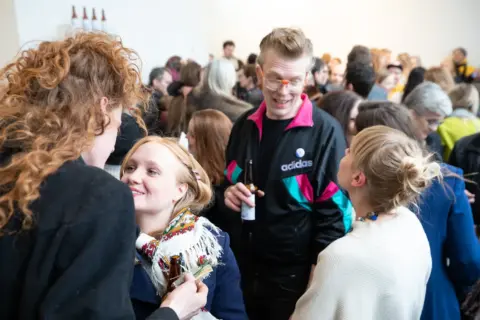
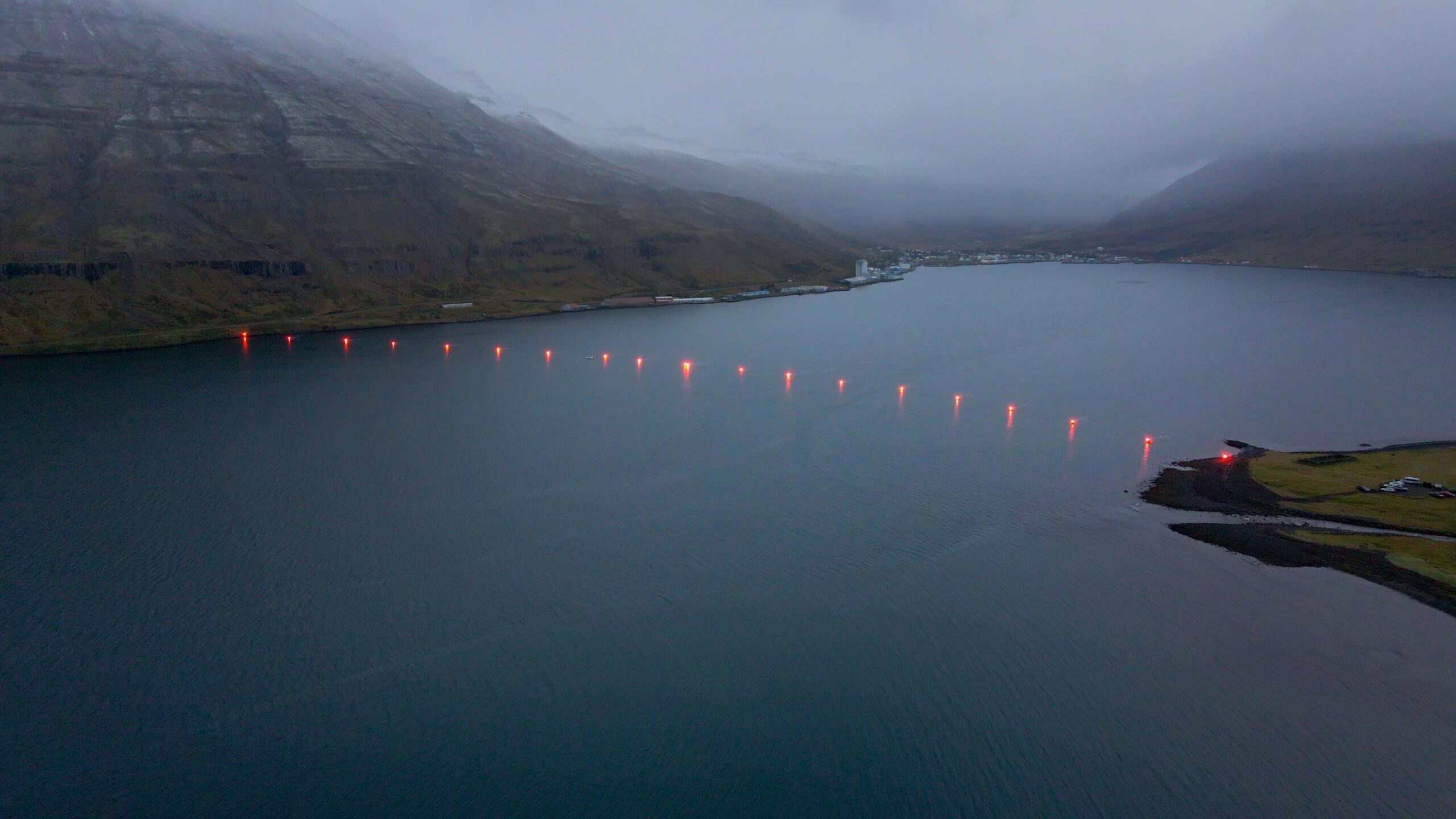
With 75% of the population against the salmon farms, a local movement has spawned a number of artistic protests, from floating ice sculptures this summer, to a line of lights strung across the fjord in October.
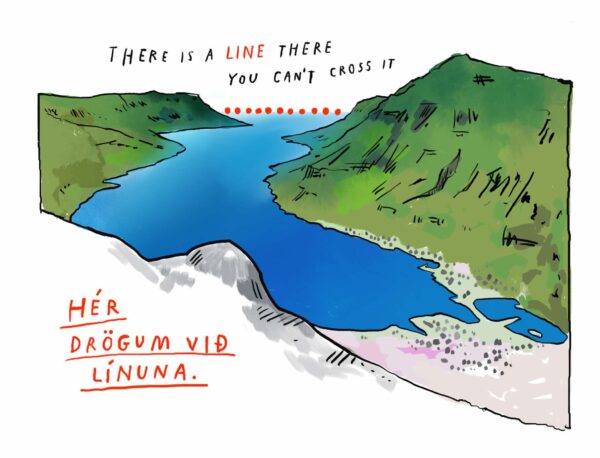
“We got together and made this line in the sea with emergency flares and closed the fjord to signify that there is a line there that can’t be crossed, it is an emergency, we don’t want this, and we are in control,” says Benedikta.
What’s the big deal?
There are a number of reasons to deny the salmon farming license, including threats to the ecology and its negative impact on a growing tourism industry. Then there’s its detrimental effect on property values and the potential for the industry to damage vital underwater infrastructure. Most significant, though, is the risk of avalanche.
“There are really strong arguments against open net-pen farming in general, but in Seyðisfjörður in particular, because there is a grave danger of avalanches,” says Katrín Oddsdóttir, a lawyer for VÁ and well known activist. One of the striking sites in Seyðisfjörður is the local museum, half of which was tragically destroyed by a mud slide four years ago.
“They have not estimated the danger of those avalanches falling on the pens themselves and destroying them with a catastrophic outcome for the wild salmon of Iceland and possibly blocking the fjord for the coast guard to help people, so this has not been estimated at all, which is crazy because the companies are applying for the pens to be inside the avalanche danger zone.”
How the avalanche assessment was conducted speaks volumes to the nature of how turnkey business is done in Iceland. Kaldvík, the company applying for the salmon farming license, requested the avalanche assessment. “The way it should have happened is the governmental institutions should have asked for it,” says Benedikta. “It’s a wrong assessment — an assessment of threat to life on land — not what could happen if the avalanche goes to the anchors of the pens with the possibility of an environmental disaster that could occur if salmon escape or if the sailing route is blocked.”
Benedikta says the town had to request a new assessment which was then added to the more than 200 comments from the community on the license application.
“I really feel they are not able to put out an operating license for the company unless they start all over again and do a proper estimation of the danger,” says Katrín. “And that will slow them down. I don’t think we are able to stop them yet, but we are slowing them down and hopefully time is on our side.”
The pressure is mounting, with the closure of the fish factory in town in 2024 resulting in the loss of 33 jobs. Already Kaldvík has begun hiring people in the community. “What is most ridiculous is that it is exploiting our ecosystem, the wild salmon, all of the tons of shit that is going to be ending up in the fjord, it is a huge sacrifice, and what we get instead is 10 to 15 jobs?” says Benedikta.
Contacted for a comment about the status of Kaldvík’s license, Karl Steinar Óskarsson, head of the Aquaculture department at MAST replied: “MAST is working on investigating some criteria mentioned in comments MAST resived [sic] during the period the proposal for license was adverticed [sic]. So this is still work in progress. Decision will be made after thorough investigation. Could take some months. We are hoping that the new law proposal for aquaculture will be put forward this fall. In there are extended mesures [sic] regarding lice and exscapees [sic].”
Terrible in every way
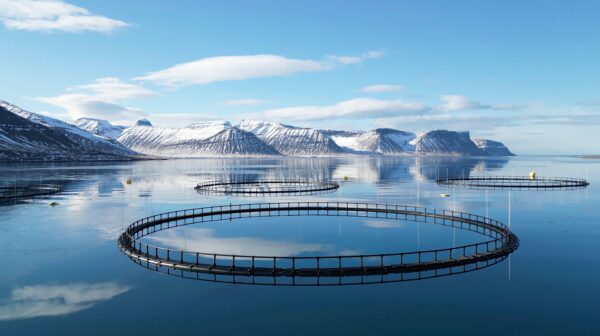
“I’m not sure why this industry is in every single aspect so terrible,” says Jón Kaldal, spokesperson for the Icelandic Wildlife Fund, who has also been fighting salmon farming. “It is polluting the fjords, ruining the ecosystems and killing the farmed animals in higher numbers than we see in any other food production.”
Half a million salmon were lost in sea pens in both November and December.
“We want a total ban in Iceland, but we also understand that the politicians will have to find a way to introduce legislation that gives companies a chance to do it in a different way,” he says. “If I had advice for the current government, I would say this should not be complicated. The legislation should focus mainly on three things: zero escapes, zero pollution and animal welfare much stricter than it is now.”
Animal welfare is one of the strongest arguments against open net-pen salmon farming in general, with massive die-offs, fish infected by sea lice and the widespread use of chemicals. “Last winter I saw two pieces by industry analysts that said ‘has the industry reached its PETA moment?’ Sometimes you don’t see it until you look in the rear view mirror, but this is the moment when things turned,” says Jón, who credits Björk with helping put the focus on animal welfare.
But the alternative to sea pens — land-based farming — may be better for the ecosystem, but it is certainly no better for the animals. On Vestmannaeyjar, where a fish processing plant also closed recently, a massive land-based salmon farm is being constructed, a dystopian technological solution to the problem of sea pens. The facility looks like a concrete oil storage depot, with 40 tanks neatly arranged like an out-take from a Matrix film, where fish will live and die in a completely artificial environment, never to see the light of day, or the natural world around them.
“I am totally against it personally,” says Jón. “Besides treating the animals badly, salmon farming is not a real food production system, it’s a food reduction system. To make one meal of farmed salmon, you need nutrients and protein that would make meals for three to five people.”
While the long term battle is focused on ending industrialized salmon farming all together, in the short term all eyes are on Seyðisfjörður.
Benedikta remains optimistic. “There is this hope that this government, with what they have in common, that they will change the way it has always been done and work for the people of their country, for whom they work. And the majority of the people are against salmon farming in open net-pens in general — and in Seyðisfjörður.”
We Draw The Line is available to watch on YouTube. VÁ’s main website is linked here, and they note that all registered with Digital ID in Iceland can sign the petition to protect the fjord.