Highway robbery: The parking meters are running on the Ring Road
Like any intrepid tourist knows, Iceland is famed for being one of the most expensive travel destinations in the world. Everything costs 3.000 ISK, no matter what you’re buying, and the cost of living only seems to go up. Many are the online comments lamenting the prices of eating out, shopping, or transiting around the island — trust us, we know from personal experience.
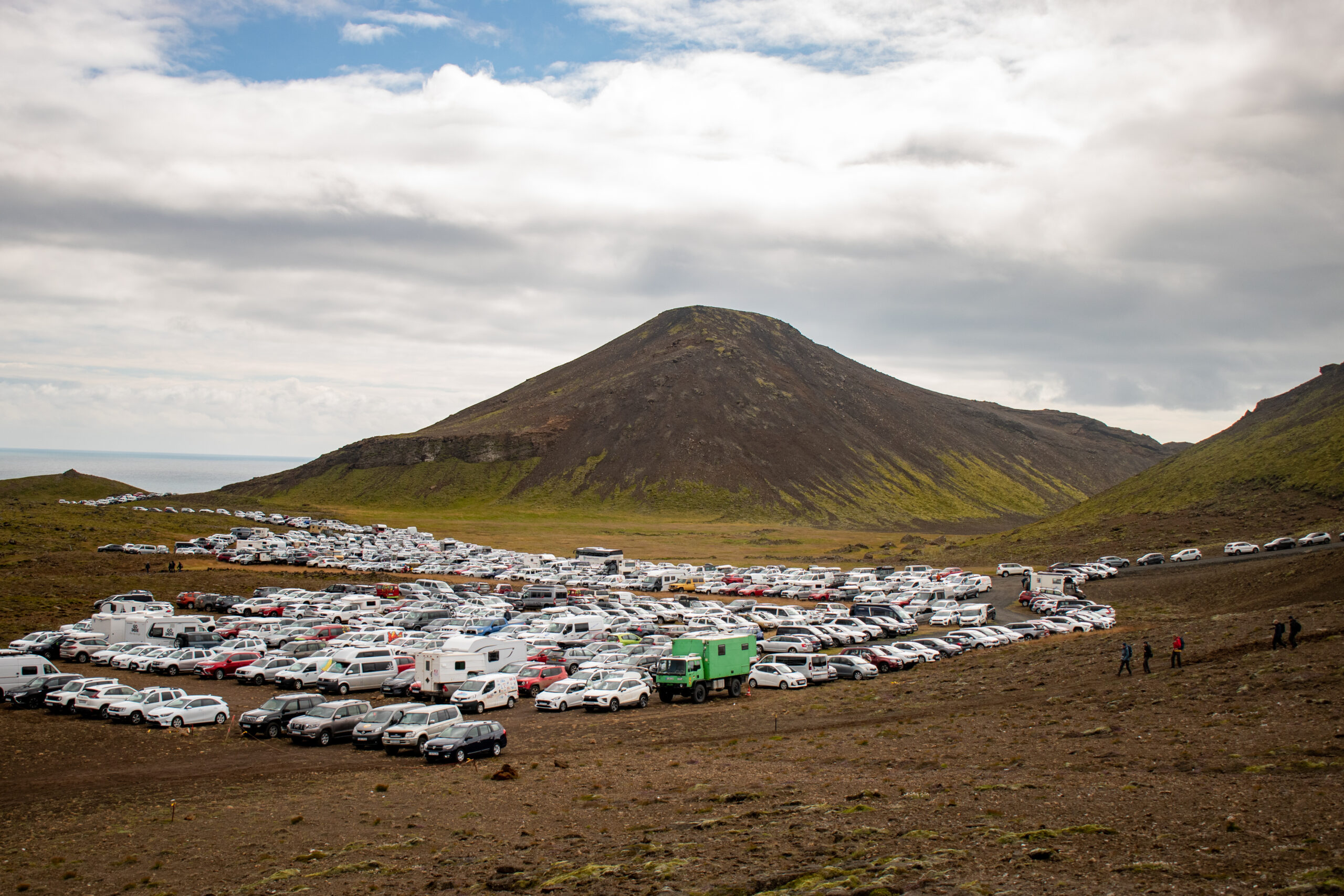
In recent years, a new cost factor has slowly emerged, hounding tourists and locals alike: car park fees around Iceland’s natural sights. According to meticulous research conducted by Grapevine HQ, corroborated by various news reports, a good chunk of the country’s most popular tourist destinations are now burdened with parking fees.
Pay as you stay
In a very Icelandic fashion, it seems that nobody ever thought about the economy of car parks. Where others saw barren lots on the side of the road, land owners and parking companies saw gold mines. In theory, parking lots are a way to negate the adverse effects of attracting an onslaught of cars, but the inconsistent implementation and ambiguous reasons for the parking fees has led many to criticise the current situation.
As reported by Vísir in 2024, pay-for parking has been implemented in at least 30 places around the country. In a conversation with the media, Director General of the Iceland Tourist Board Arnar Már Ólafsson described the situation as “out of control”. “The parking fees stir up a philosophical question: how accessible should Iceland’s nature be?”
On average, the run-of-the-mill five-seat sedan can be expected to fork out approximately 1.000 ISK each time its passengers want to grab a nice photo-op with an Icelandic waterfall.
Let’s take an example of what it might cost to park at the main sights on one of the most popular drives in Iceland. The Golden Circle alone now has four locations that charge parking; Þingvellir, Geysir, Brúarárhlöð and Kerið. Apart from Kerið, which charges 600 ISK, parking at the other places will set you back 1.000 ISK. The drive along Iceland’s south coast features at least 15 places that charge for parking, peaking at 1.000 ISK. These places of interest include Seljalandsfoss, Skógafoss, Reynisfjara, Fjaðrárgljúfur, Skaftafell and Jökulsárlón. It’s not hard to imagine the bill for such a road trip hitting the 20.000 ISK mark pretty quickly.
As noted by reports made by Vísir and Heimildin, the parking fees stir up a philosophical question: how accessible should Iceland’s nature be? In conversation with Heimildin, former professor emeritus of sociology Stefán Ólafsson mentioned that the pricing falls hard on low-income Icelanders, as the ability to travel around their home country becomes increasingly expensive.
Getting fined for parking fines
The largest proprietor overseeing and deciding these parking fees is the company Parka, which also manages select Reykjavík parking lots and campsites. In a report from Heimildin, the company owner blames the state for setting the standard, pointing out that parking at Þingvellir National Park — managed by the state — costs approximately 1.000 ISK.
One of the main critiques against this current arrangement are the extortive late fees exercised by the parking companies. Last June, The Icelandic Consumer Agency fined some of the companies responsible for handling the parking fees stating that, “The companies had violated the Act on Good Business Practices as well as the rules on price marking by not providing information about all fees associated with the parking spaces.”
Furthermore, the agency “also considered that there was a violation of the law in cases where the demarcation of paid parking spaces was not sufficiently clear, and that it was considered misleading business practices to make it appear that automatic payment systems or charging were in place without stating that such needed to be activated separately or that the system was not in place.”
The fines tend to be three to four times higher compared to the original parking fee. For tourists visiting these locations on a rental car, those fines will be levied from their credit cards — often after they’ve left the country, leaving travellers with a bad impression of Iceland.
Overcharged and underwhelmed
One of the arguments for implementing these practices is to fund the necessary infrastructure maintenance happening in and around these locations. However, as Heimildin reported, most of these locations receive a hefty grant — from a pool of 500 million ISK — to carry out their maintenance duties.
In some cases, although there is direct correlation between the fees and the services or infrastructure provided on location, this is far from being a general rule. For example, the 1.000 ISK parking fee at Brúarfoss on the Golden Circle comes with no facilities whatsoever, with the surrounding paths being lacklustre at best. This has prompted numerous visitors to submit an online complaint on TripAdvisor or Google Reviews.
If one dives into online reviews of many of Iceland’s most frequently visited sites, the complaints mount as many visitors find the balance between the fees paid and the services provided to be skewed, leaving them feeling overcharged and underwhelmed. “Many visitors find the balance between the fees paid and the services provided to be skewed, leaving them feeling overcharged and underwhelmed.”
Do we need a policy?
Last December, the Icelandic government released its first (yes, you read that correctly) policy paper on tourism. It’s a remarkable feat, considering the fact that tourism has been the largest industry in Iceland on and off during the last decade, even surpassing the fisheries industry. The paper states that a task force needs to be formed to examine the possibility of using fees to control access to popular destinations in Iceland. To begin with, that focus should be placed on popular destinations owned by the government. The policy paper doesn’t acknowledge the fact that dozens of popular privately owned tourist destinations are already collecting parking fees, and as of yet, no policy has been enacted or even suggested by the state. Meanwhile, the parking meter keeps ticking, and the online reviews keep piling up.
Alternative solutions
To solve this problem, we might suggest building a high-speed rail network around the country. Failing that, the next best thing would be to properly formulate comprehensive policies that counter the emergence of highway grifters. So many of Iceland’s issues could be prevented just by identifying the problem before it turns into one. But no one did, and here we are, complaining about car park fees. Wait. Do you think that idea is bonkers? We’ve got another one for you.
Alternative history solution
Say we were gifted a time machine. We would go back in time to Iceland the summer of 1809 — in the middle of the Napoleonic Wars. During that summer, a Danish sailor, in the service of the British government, enacted an unsolicited coup d’etat and declared himself the ruler of Iceland. The British navy would have none of this, and removed Jörgen from Iceland later that summer and then restored Danish rule to Iceland. Alternatively, the British Empire might have taken over Iceland, a move that could have landed us with a railway system, as that was the legacy of British Imperial rule in most other countries. Hence, parking problem solved.