When Iceland recognised Palestine in 2011, it made Israel furious. Fourteen years later, an Icelandic ex-MP helped free an Israeli hostage from an Iranian-backed militia in Baghdad. How does that work?
The short answer is that Iceland gets to play a different game than most countries. The longer answer is messier, and it involves Birgir Þórarinsson, a former Independence Party MP about whom most Grapevine readers will have strong opinions one way or the other. In Baghdad, the stories of two unlikely figures crossed.
Birgir Þórarinsson, a conservative ex-MP from Keflavík, helped secure the release of Elizabeth Tsurkov, a left-wing Israeli researcher who had spent her career defending Palestinian rights. He was an improbable envoy. She was an improbable hostage. Their encounter unsettles easy assumptions about both Icelandic politics and Israeli identity, and it shows how Iceland can sometimes move in places where larger powers cannot. “In Iceland’s small-community society, even senior leaders are approachable. He brought that belief to complex international affairs.”
The hostage
Elizabeth Tsurkov was born in Leningrad in 1986. She was four when her Jewish parents left the collapsing Soviet Union for Israel. This was at the beginning of a massive exodus. Between 1989 and 2006, roughly a million Soviet Jews moved to Israel, fleeing decades of state-sponsored antisemitism. It barred them from universities and professions, marked “Jewish” on their internal passports, and made them second-class citizens in their own country. When Gorbachev loosened exit controls, hundreds of thousands took the first chance they had to leave.
Tsurkov did her mandatory IDF service, learned Arabic, and by 2014 was volunteering at an Israeli NGO that works for asylum seekers and migrant workers. She wrote for +972 Magazine, a left-wing publication that criticises Israeli occupation. During the 2014 Gaza war, she wrote an op-ed in the New York Times arguing that Israeli policy was strengthening Hamas rather than weakening it. She advocated publicly for Palestinian rights. She was exactly the kind of Israeli the current government finds inconvenient.
By January 2023, she was in the United States finishing a Princeton PhD on Shiite political movements in Iraq. She had done fieldwork in Syria, Jordan, and Turkey. She had been to Iraq before without incident. On March 21, 2023, six months before October 7, she was grabbed off the street in Baghdad’s Karrada district. Kataeb Hezbollah, an Iranian-backed militia embedded in Iraq’s security apparatus, took her. They claimed she was a spy. Her family said she was not. What is clear is that her Israeli citizenship made her useful to people who did not care about her actual beliefs. The irony that her years advocating for Palestinian rights meant nothing to her captors is the kind of detail that gets lost in geopolitics.
For 903 days, she existed in a bureaucratic no man’s land. The Iraqi government said it was working on the case but had limited authority. The Americans pushed but could not push too hard. The Israelis tried quiet channels but were limited. After October 7, when hundreds of Israelis were taken hostage in Gaza, the Israeli government’s bandwidth for a case in Baghdad involving someone politically inconvenient evaporated. Kataeb Hezbollah wanted 200 million dollars and a prisoner exchange. The case stalled.
Then an Icelandic ex-MP with no official role started making trips to Tehran and Baghdad.
The Icelander
Birgir Þórarinsson is 60, and lives on a windswept property with records in Icelandic history going back to the 15th century. It sits between Reykjavík and the Keflavík airport, but a world away from both. He studied theology in Iceland and received a graduate degree in international service in the United States. His faith and curiosity carried him outward.
He began his career in the airport fire department. Between 2014 and 2016, he worked for UNRWA, the UN agency for Palestinian refugees in Jerusalem, Gaza and the West Bank. He lived with a Palestinian family in East Jerusalem. He gained affection for the region and the people. He came to believe life could be better for them, if not for corruption and extremism.
He was elected to Parliament in 2017. Until 2024, he was an MP, first with Miðflokkurinn, then with the Independence Party. For those readers familiar with Icelandic politics, that trajectory will tell you most of what you need to know. Both are conservative parties. He served on the foreign affairs committee and chaired Iceland’s delegation in Europe’s security cooperation. He became Chair of the OSCE’s Political Affairs and Security Committee, the first Icelander to hold that position. Soon he was tapped to become a rapporteur for the Council of Europe on Afghan refugees, where he went beyond the Council’s guidance to travel to Turkey, Afghanistan, and even Iran to connect directly with the people on the ground.
In Iceland’s small-community society, even senior leaders are approachable. He brought that belief to complex international affairs. When he visited Afghanistan, a year after the US’s hasty withdrawal, he was the first elected official to meet with the Taliban government in Kabul. In 2023, he joined a humanitarian mission to Iraq, where he met with the persecuted Yazidi minority. It was on that trip he met Khassan Saka, an Iraqi-Canadian activist who would later prove crucial. “Birgir told me later: ‘This woman was on my heart.’”
As a rapporteur on Afghanistan for the Parliamentary Assembly of the Council of Europe, Birgir had spent time in Iran talking to officials about refugees.
In April 2023, a month after Tsurkov disappeared, he saw a video of her sister Emma confronting Iraq’s prime minister at an Atlantic Council event in Washington. Emma stood up and started shouting. “She’s held hostage in your country. You are not doing anything to save her. They are your government’s partners.”
Birgir told me later: “This woman was on my heart.”
The work
Birgir asked the honorary consul of Iceland in Israel for an introduction. A few days later, he was on a call with Emma, offering to help. Emma connected him to Mickey Bergman of Global Reach, a private American organisation that assists in the return of hostages and political prisoners. The problem was that Kataeb Hezbollah wanted 200 million dollars, and neither the US nor Israel was going to pay a ransom. The Tsurkov family would end up covering Birgir’s travel expenses for the trips that followed.
According to the Times of Israel, Birgir said, “The US was much more interested in this case than the Israelis.” The sequence is clear even without proof of causation. Israeli citizen. Inconvenient politics. Less Israeli government engagement than American. Governments prioritise hostages whose politics align with their own. That is uncomfortable but worth naming.
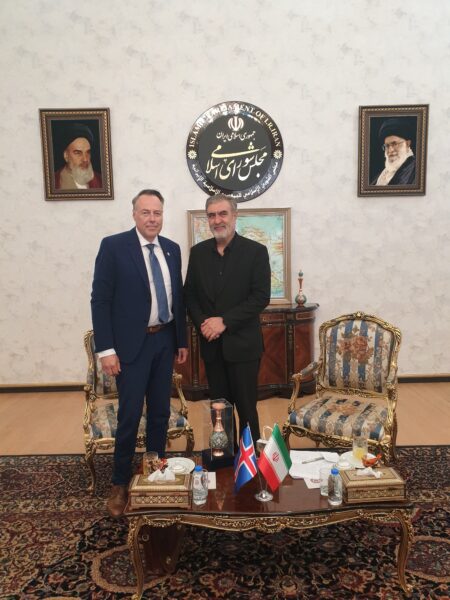
In July 2024, Birgir flew to Oslo and met the Iranian ambassador, who arranged contacts in Tehran and invited him to the presidential inauguration. He was warned not to go. Mickey Bergman, who knew the risks, told him he might be kidnapped himself. But he was an official invited guest. He went anyway.
Two days before the inauguration, Birgir met Iranian officials. The day of the inauguration, he sat in the VIP room in the Iranian parliament with Islamic leaders, including the Taliban. He thought for a moment, where am I? In the hours after the inauguration, Israel assassinated Hamas leader Ismail Haniyeh in Tehran. Birgir had briefly stood beside Haniyeh at the inauguration. Suddenly he was being raced through the city to the airport as the news broke. There were concerns that the airport would close, and he would be stuck. Iran promised retaliation. The regional situation went incendiary. Any progress evaporated.
In September 2024, Birgir tried to organise a parliamentary delegation to Iraq. Israel escalated against Hezbollah in Lebanon that same month, detonating explosives in pagers and walkie-talkies across Lebanon, killing and maiming hundreds. The trip was cancelled. “Mickey Bergman, who knew the risks, told him he might be kidnapped himself. But he was an official invited guest. He went anyway.”
The breakthrough came in April 2025 at a prayer breakfast in Erbil. Birgir and his wife attended the Kurdish gathering, where he met again with Khassan Saka, who introduced him to an adviser to Ammar al-Hakim, one of the most powerful Shiite clerics in Iraq. The adviser arranged a meeting in Baghdad for May.
Birgir had a backup plan as well. Prior to the Hakim meeting in Baghdad, he also met with Rayan al-Kildani, an Assyrian Christian militia leader sanctioned by the US for human rights violations. Birgir was warned about al-Kildani’s reputation. Birgir made a point not to Google him before their meeting. He knew al-Kildani had direct contact with Kataeb Hezbollah. If Hakim couldn’t help, Birgir planned to work through al-Kildani.
The meeting with Hakim went forward. Birgir waited in a reception hall that served as a museum. Saddam Hussein’s golden rifles lined the walls alongside gifts from foreign countries. Hakim cancelled other appointments to make time. The meeting lasted 70 minutes. Birgir brought gifts from Iceland: a photo book of Icelandic landscapes and a Viking-style chess set. Hakim had little familiarity with Iceland but found it remarkable that an Icelander was working to free Tsurkov. He looked at photos of Icelandic sheep and was impressed.
According to Birgir’s account, Hakim explained that October 7 had made everything harder. What might have been resolved quickly had turned symbolic. He also said that kidnapping a woman was disrespectful, not done in the old days. Hakim also told Birgir that American negotiators had threatened Iraq with military force if Tsurkov was not released within 48 hours. Birgir believes this threat delayed her release by months. The sensitivity around American military threats in Iraq, given the country’s history, cannot be overstated.
Birgir’s main request, he told me, was simple. “I asked if he could try to get a waiver for the ransom. And then, suddenly, they did.”
Three days later, Hakim’s office informed Birgir that Kataeb Hezbollah had agreed to waive the ransom entirely. When he informed the American officials, they did not believe him. Whether this was because of Birgir, or sustained Iraqi pressure, or American warnings, or some combination, is impossible to untangle. What is clear is that removing the ransom demand unlocked the case.
Four months later, on September 9, 2025, Kataeb Hezbollah brought Tsurkov to a location in Baghdad and left her there. Iraqi officials collected her. She was taken to the US embassy, then flown to Greece and on to Israel. She had been held for 903 days.
Birgir told Vísir that freeing her “without military force and without ransom was in truth a miracle.”
Mickey Bergman, who had been working with the family throughout, texted Birgir afterwards. “Thank you for everything you’ve done. It’s been tremendous!”
The reputation
In 1986, Reagan and Gorbachev met at Höfði House. The summit collapsed, but it opened technical questions about arms verification that led to the INF Treaty. In 1991, Iceland was the first country to recognise the restored independence of Estonia, Latvia and Lithuania, when the Soviet Union still existed and the outcome was uncertain. Baltic leaders still call it the move that “broke the geopolitical ice.” In 2011, Iceland became the first country in Western or Northern Europe to recognise Palestine as a state. In 2021, Iceland hosted a Blinken-Lavrov bilateral at the Arctic Council ministerial, one of the few direct meetings between American and Russian officials that year.
Iceland takes positions that larger countries find inconvenient, and then Iceland gets to sit in rooms where larger countries cannot. That only works if people believe Iceland is playing a different game.
Birgir believes being Icelandic was central. He told Vísir: “I can say without hesitation that respect is shown for Iceland on the international stage. It mattered that Iceland is a peaceful country, has no enemies and threatens no state. I enjoyed undisputed trust in these discussions.”
But what enabled Birgir was not credibility in any institutional sense. It was something stranger and more Icelandic. Faith in personal relationships. Confident naïveté. A dose of global irrelevance reframed as virtue.
When Birgir sat down with Ammar al-Hakim in Baghdad, he brought a photo book and a chess set. He came with no leverage, no hidden agenda, and therefore no threat. In a region wary of power, irrelevance can be the highest form of trust. That is not neutrality. That is smallness turned into access.
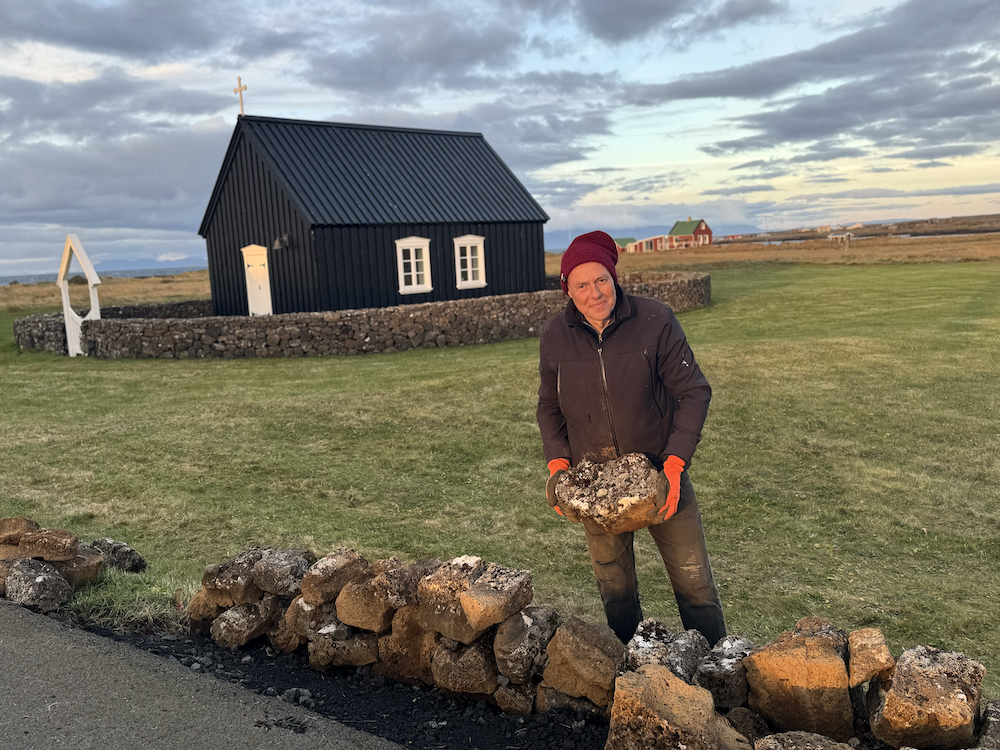
Back in Iceland, Birgir now spends his days building stone walls on his property next to the ocean. He harvests the rock by hand from the surrounding countryside. The black church on the property, built in the Icelandic style, he also constructed himself. In his home, Persian rugs from his travels line the floor.
Birgir insists this story is about Iceland, not him. He might be right. After the story broke, he was surprised by how Icelanders reacted. “People just saw that Iceland can do something to help,” he told me. There was pride in it. The kind of quiet validation that comes from discovering a national trait you did not know was still useful.