

These guidelines apply to freelance writers and staff writers alike. Please follow them closely.
Article Lengths
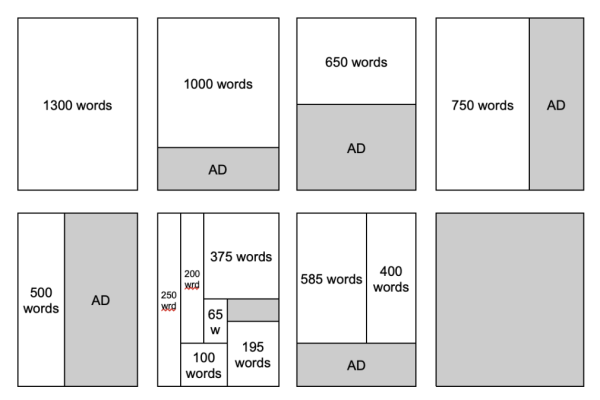
Be mindful of the wordcount your article has been assigned. If you do not have any wordcount assigned to your article, consult the Editor-in-Chief. If you have been assigned a wordcount and you feel the material you are writing about needs more space, consult the Editor-in-Chief. If you don’t, you risk your article being edited down to fit its assigned space, hence creating more work for an already busy editor. Below you can see how many words specific spaces in The Reykjavík Grapevine can accommodate. Respect these limitations.
Deadlines
The deadline for the printed issue is Wednesday, a week before print. Deviations from this rule must be negotiated with the Editor-in-Chief. You can find the upcoming publication dates here.
For the web, deadlines are negotiated on a case-by-case basis.
General formatting
- If you are a staff writer or a regular contributor your document should be a Google Doc., submitted by “sharing” with the Editor-in-Chief. Make sure the settings of the document allow for editing. If not, your document should be in the .doc or .docX format (MS Word) and sent to editor@grapevine.is
- The text should be set to Arial.
- Your font size should be 12 pt. (this goes for headlines, subheadlines, and everything else you can think of).
- The text should be left-aligned.
- The document’s language should be set to UK English (File>Language>English (United Kingdom) in Google Docs) and it should be thoroughly spell-checked when you turn it in. (Also, when interviewing people, ask them to spell out their names, including Icelandic characters and accents. When quoting names of places or persons or establishments, make sure that you double-check the spelling).
- Your document should include an eye-catching unique headline, a descriptive sub headline and section headlines every two or three paragraphs whenever an article exceeds 400 words.
- Capitalise the first letter of every word in the title (including your “the” and “and”), no full stop. For sub headlines, only capitalise the first letter of the first word, and no full stop.
- Every article should be sent in with a by line with the author’s name written as the author intends it to be spelled. Also include a photographer credit if you know what it is.
- Every article should include an introductory paragraph, a.k.a. “lede paragraph.”
- All articles exceeding 400 words should come with a a pull-quote suggestion.
- All additional info, e.g. on concert dates or gallery opening hours, and the like — should be placed at the beginning of the article’s document.
Other Style Rules
- Numbers: Spell out numbers one through nine. Spell out a number if it comes at the start of a sentence. Use numerals for 10 and over (10, 20, 30, 5 million, 7.6 billion).
- Dates: Month then day e.g. November 21 (except in listings: Nov. 21); If needing to note the year, use “Month DD, YYYY”
- Decades: Use 1960s or Sixties — not 1960’s or 60’s.
- Time: 24-hour clock: 00:00 (midnight), 23:30, 12:00 (noon).
- Currency: Use a full stop to separate thousands, then a space before the currency: e.g. 13.000 ISK, 13.000 USD.
- Measurements: Use space between the number and the unit e.g. 5 km, 20 m, 3.5 tonnes
- Percent: We will use written percent, as opposed to “%”, where possible.
- Italics: Italicise film, book, album and exhibition titles. Place song and article titles in “double quotations”.
- Titles: Capitalise formal titles preceding names; use name only on second mention; lower case titles when no name is attached. Former office holder titles are always lowercase.
- Punctuations: Keep punctuation inside quotes.
- Names: We are an Icelandic magazine, and for fun, we like to use people’s first names to refer to them (after we have introduced them with their full name). For example, here is how an interview with current Prime Minister Kristrún Frostadóttir would look: “Iceland’s Prime Minister Kristrún Frostadóttir heavily opposed raising taxes on companies when that matter was up for discussion in the early ‘20s [NOTE: YOU SAY ‘20s, not 20’s]. Kristrún said that she feared increased taxation “might undermine the solid capitalistic foundations of modern society.” If the person has a non-Icelandic name but either is an Icelandic citizen, or dealt with in Icelandic context, we would use first name. If the subject is NOT WITHIN ICELAND, surnames would be used in second mention. (For example, Trump, not Donald, unless we are intentionally violating standards for humor purposes.) Reminder: A patronymic is NOT a surname.
- Em dash: We use em dashes flanked by a single space. “Amanda’s boyfriend — a known drug addict — was high on crack, heroin, LSD and MDMA.” Also, we use the three em dash because there is no god.
- Bands: If bands have more than one person, we refer to them as a group, and not a single entity. E.g. “GusGus are going on tour,” not “GusGus is going on tour.
- Miscellaneous: Use Icelandic spelling when referring to a cultural event, e.g., Þorrablót, 17. Júní.
- Nicknames: Spell nickname in quotations after first name, e.g. Guðmundur “Kiddi” Kristinn Jónsson.
Important
Quote correctly. If an interview takes place in a second language for the subject (or if you are translating, say, from Icelandic), they can be allowed to see the quotes before they go in print. They can NOT see the ARTICLE, however (unless special circumstances call for it, in which case you should consult your editor).
Also, subjects must be made aware that only language concerns may be corrected. If the subject has second thoughts about offending someone, that is not our fault – if you have the quotes on tape, and you feel they are essential to the story, you may run the quotes WITH a comment explaining that you are running it AGAINST the subjects wishes (realize that Iceland is a small country, and the subject will probably injure you at a later place and time if you do this).